

Railway Power Solutions at InnoTrans 2026 | Premium PSU
Visit us at InnoTrans 2026, Hall 17 Stand 425. Our team will be available throughout the four days to discuss railway power solutions, onboard converters and DIN rail systems for demanding environments.

Thermal Design in Power Electronics
From thermal budget and Arrhenius law to active temperature management: DFR methodology and concurrent design in SiC/GaN converters

Barcelona, the epicentre of the AI energy revolution.
A view from the OCP EMEA Summit 2026 — and a message to the Spanish industrial base of pumps, heat exchangers, valves and fluid systems

Premium SA at OCP EMEA Summit 2026 Barcelona: Industrial Discipline for the 800 V DC Era
The shift from 48V to 800V DC bus: Premium PSU's engineering analysis of OCP Open Rack v3 and what the high-voltage transition means for data center power.
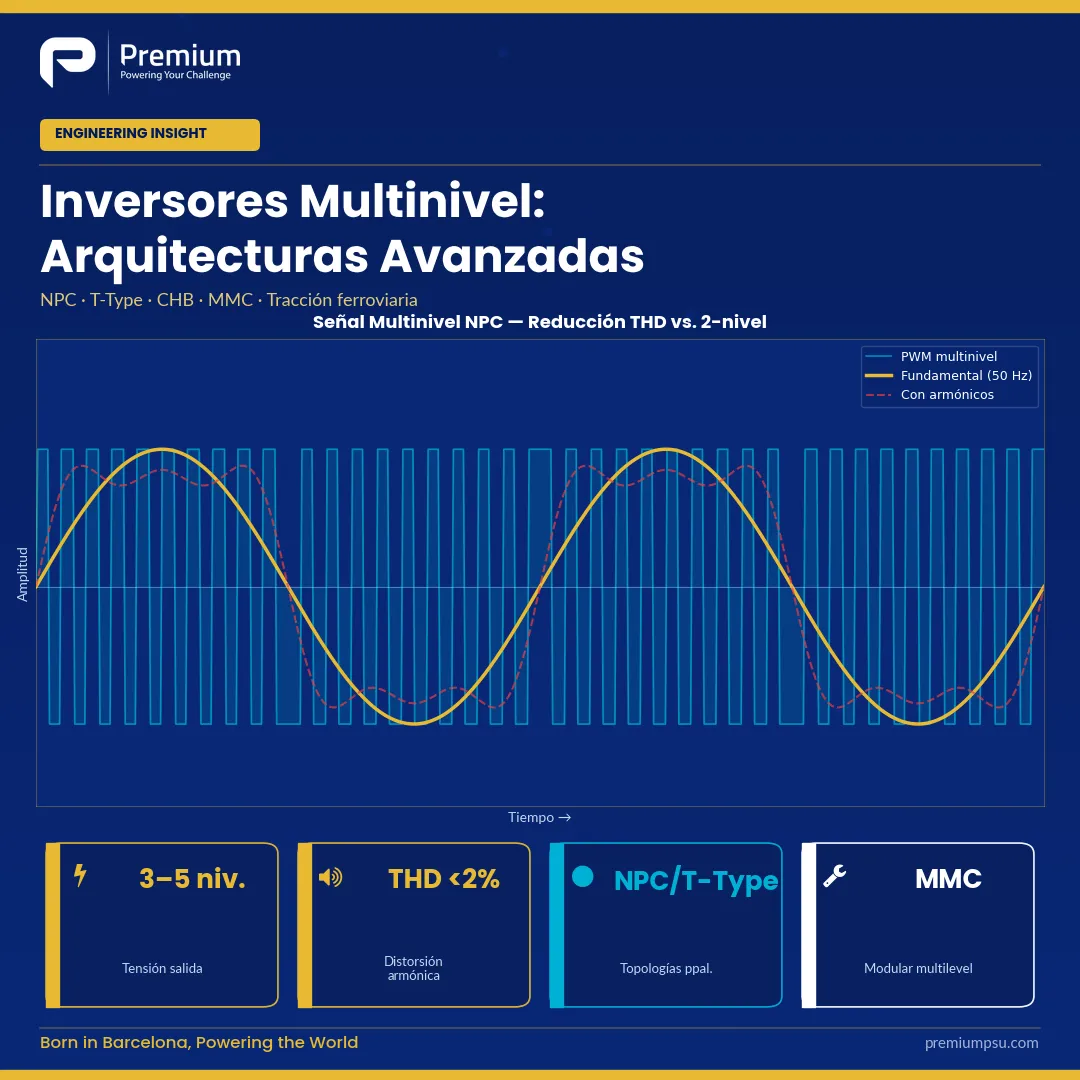
Multilevel Inverters: NPC, FC, CHB and the Road to RDC-MLI
From conventional two-level to neutral-point clamped, flying capacitor, cascaded H-bridge and reduced device count topologies — architectural synthesis for traction, grids and renewables

Premium PSU Joins the Open Compute Project: Power Architectures for the Next Generation of Data Centers
Premium PSU joins the Open Compute Project (OCP) to contribute power electronics expertise to Open Rack and hyperscale data center architectures.

Sustainable Growth and International Expansion Through Digitalization
Implementation of Green and Digital Technologies Based on Regenerative Loads

Xpande Digital: Premium PSU's Action Plan for digital transformation and online promotion
Action Plan with the objective of improving its competitiveness through digital transformation, online promotion, and e-commerce in international markets during 2025–2026.

Wide bandgap semiconductors for next-generation data centers
The rapid growth of artificial intelligence, cloud computing and large-scale data processing is reshaping the energy requirements of modern data centers. In this new scenario, efficiency, power density and reliable operation under increasingly demanding loads have become key factors in power infrastructure design.